Bodymind Happy Womb – Women’s Massage for Endometriosis


Endometriosis does not affect only tissue. It affects the entire Bodymind system. Chronic pain changes muscle tone, breathing, the nervous system, the pelvic floor, emotional safety, and the relationship to the lower abdomen.
Medically, endometriosis means that tissue similar to the uterine lining grows outside the uterus. This tissue can react to the menstrual cycle, cause inflammation, and form adhesions.
At the same time, over months or years, the nervous system learns to transmit pain faster and more intensely. Muscles in the pelvis and abdomen enter a state of constant protective tension.
This is where Bodymind Happy Womb – Women’s Massage comes in: not as a treatment for the disease itself, but as body-oriented regulation of protective tension, stress responses, and pain-amplifying circuits. The goal is a body that feels inhabitable, safe, and alive again.
When there is not yet a diagnosis – three important orientation questions
Many clients come without a confirmed diagnosis, but with a suspicion of endometriosis. It is helpful to keep a few simple questions in mind to distinguish typical endometriosis patterns from classic PMS or other cycle-related complaints.
The first question is:
Is the pain stronger than typical menstrual pain and does it significantly limit daily life, work, sleep, or movement? In PMS, tension or mild cramps are common. In endometriosis, many affected people experience deep, stabbing, or burning pain with clear limitations in quality of life.
The second question is:
Does pain occur outside menstruation, for example during ovulation, during sexual intercourse, during bowel movements, or independently of the cycle? PMS usually remains limited to the days before bleeding.
The third question is:
Are there cycle-related bowel or bladder symptoms such as bloating, painful bowel movements, constipation, diarrhea, or burning during urination? These patterns are common in endometriosis.
These questions do not replace medical diagnosis, but they provide a clear language for conversations with medical professionals and Bodymind bodywork therapists.
What should I communicate to Bodymind bodywork therapists if I suspect endometriosis?
If there is a suspicion, it is important to communicate it openly, even without a confirmed diagnosis.
Relevant information includes strong cycle-related lower abdominal pain, pain outside menstruation, pain during sexual intercourse, bowel movements or urination, regular use of pain medication, and any gynecological examinations already done.
For Bodymind bodywork therapists, this information is essential to adapt touch intensity, depth of work, and safety boundaries correctly. A simple sentence such as:“There is a suspicion of endometriosis. Please avoid deep pressure on the abdomen or internal organs.”is enough to ensure a safe treatment.
Can I receive the abdominal and Womb part if I have endometriosis?
Yes, in an adapted and safe form.
In Bodymind Happy Womb – Women’s Massage, no deep pressure is applied to the uterus, ovaries, or intestines.
The uterus is the organ of pregnancy.
The ovaries produce hormones and eggs.
The intestines partly run behind the uterus.
In endometriosis, sensitive lesions or adhesions may exist in these areas, which cannot be reliably detected from the outside.
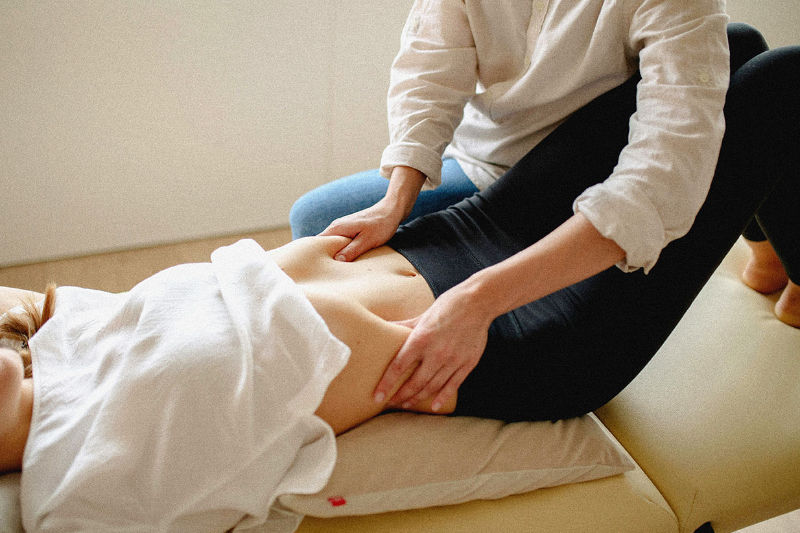
Therefore, Bodymind Happy Womb – Women’s Massage works with gentle external touch on the abdominal wall, flanks, pelvic ring, and breathing space.
The Womb part is a breath- and nervous-system-oriented contact with the lower abdomen, not a manipulation of internal organs. Fascia are fine connective tissue layers surrounding muscles, organs, and nerves, reacting strongly to stress and protective tension.
The abdomen is touched only pain-free, slowly, and broadly, in continuous dialogue with the client. The goal is to release protective tension, calm the autonomic nervous system, and restore a sense of bodily safety.
Which body areas are actually touched?
Bodymind Happy Womb – Women’s Massage works with regions that typically enter protective tension or contribute to pain amplification in endometriosis.
These include:
abdominal wall
diaphragm area as the main breathing muscle
flanks
pelvic ring
sacroiliac region in the lower back
lumbar fascia
hip flexors
inner thigh adductors
external pelvic floor structures
chest
neck
breathing spaces
These regions influence pelvic nerve supply, circulation, breathing mechanics, and muscle tone. Touch remains within skin, fascia, and muscle layers.
In the Womb part, internal organs are not pressed; instead, soft contact surfaces are used to support parasympathetic regulation. The parasympathetic nervous system is responsible for rest, digestion, and regeneration.
Which areas are intentionally not manipulated – and why?
Direct pressure on the uterus, ovaries, or deep intestinal palpation is avoided in endometriosis.
Endometriomas, adhesions, or deep intestinal involvement cannot be reliably recognized from outside. Mechanical pressure could increase pain or irritate tissues.
Very deep trigger point work in the lower abdomen is also avoided, as it often activates rather than calms the nervous system. In Bodymind Happy Womb – Women’s Massage, the principle is: safety before intensity.
This approach aligns with current medical guidelines recommending pain-adapted and non-aggressive body-oriented support in endometriosis.
What should be considered before and during treatment?
Before the first session, an in-depth intake conversation takes place covering symptoms, cycle phase, pain quality, previous surgeries, and current complaints. Treatment is not performed during acute inflammation, very heavy bleeding, or unexplained sudden pain worsening.
During the massage, the client can stop or modify the treatment at any time. Continuous dialogue gives the nervous system a sense of control and safety, which is central to pain regulation.
After the session, possible responses are observed. Mild fatigue or warmth are normal regulation signs. New strong pain, fever, or unusual symptoms require medical evaluation.
Why this work can be helpful in endometriosis
Studies on multimodal endometriosis rehabilitation show improvements in pain, mobility, pelvic floor function, and quality of life through pelvic floor downtraining, myofascial techniques, and nervous-system-oriented bodywork.
The effect does not come from “curing endometriosis,” but from reducing chronic protective tension, calming vagal pathways, and interrupting pain-amplifying circuits.
Bodymind Happy Womb – Women’s Massage follows this logic:Regulation instead of manipulation. Safety instead of intensity.Relationship instead of technique.
Why choose only certified Bodymind bodywork therapists?
Bodymind Happy Womb – Women’s Massage requires solid knowledge of anatomy, physiology, neurology, pain mechanisms, and the physiology of menstruation and menopause.
Bodymind bodywork therapists are trained specifically in these fields. They learn to conduct a mandatory intake session, ask the right questions, recognize risks, and personalize each treatment.
Certification includes extensive theoretical and practical training hours, anatomy exams, hands-on technique tests, supervision, and a final qualitative competency assessment. Only after this is permission granted to offer this work professionally.
Many so-called “intuitive” or purely “energetic” massage services lack verifiable training standards, tested anatomical knowledge, and structured safety protocols. Touch itself is not wrong, but in complex conditions like endometriosis, safety and quality depend on verified competence.
The difference is not marketing, but demonstrable expertise, clinical safety, and professional responsibility. Anyone who takes their body seriously checks training, curriculum, and certification of their therapist—especially when working with the abdomen and pelvis.
Scientific notes and evidence
ESHRE Guideline for Endometriosis, 2022. International guideline on diagnosis and multimodal treatment of endometriosis.
NICE Guideline NG73 – Endometriosis: diagnosis and management. Recommendations for individualized multimodal therapy in chronic pelvic pain.
ACOG Practice Bulletin – Chronic Pelvic Pain. Role of pelvic floor physiotherapy and myofascial work.
Wójcik M. et al. Physiotherapy management in endometriosis. Reviews on myofascial treatment and pelvic floor downtraining.
Torosis M. et al. Treatment algorithm for high-tone pelvic floor dysfunction. Evidence-based manual approaches for pelvic floor regulation.
De Strooper M. et al. Manual and visceral therapy in endometriosis – scoping review. Positive indications with still heterogeneous evidence.
Rodríguez-Ruiz Á. et al. Physical rehabilitation in endometriosis and adenomyosis. Effects on function and quality of life.
Pain research on central sensitization (Woolf, Moseley, Butler): mechanisms of pain modulation through safe touch and nervous-system-oriented regulation.