
The Therapeutic Art of Regulating Energy and Activating the Vagus Nerve
A perspective from Bodymind Therapy
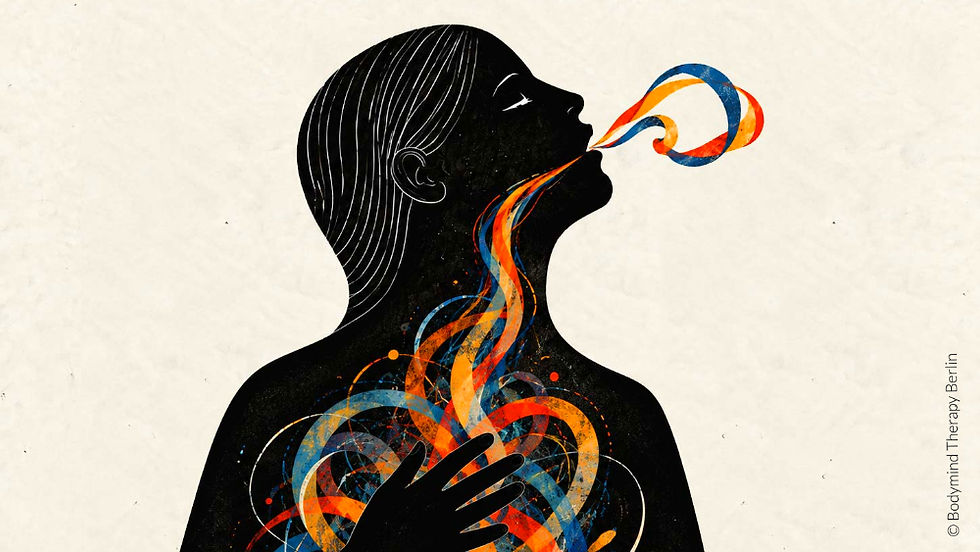
In Bodymind Therapy, the psychosomatic capacity known as Management of Energy is not merely about reducing stress. It refers to the conscious ability to access, contain, modulate, and ultimately express one’s inner energy in a coherent way—through the body, the voice, and relational presence.
At the heart of this process lies the fine-tuned regulation of the autonomic nervous system, with the vagus nerve playing a key role.
How Energy Regulation Develops
According to research from the Bodynamic Institute, this function begins developing early in life, especially during the Eriksonian phases related to autonomy and will.
In these formative years, children learn to sense their impulses, regulate internal arousal, and navigate between inner needs and external demands.
The quality of early relationships is crucial here: they shape whether the nervous system learns to stay connected even in moments of strong internal activation.
The Role of the Vagus Nerve
The vagus nerve—part of the parasympathetic nervous system—is a major player in this regulation. It supports transitions from activation to calm and facilitates digestion, rest, and slowing down.
Its ventral branch, central to Polyvagal Theory, is closely linked to social safety, heart coherence, and emotional openness. When this part is active, it positively influences our presence and relational capacity.
Trauma, Chronic Stress, and the Nervous System
In systems shaped by trauma—whether developmental trauma, shock, or chronic stress—the autonomic nervous system often loses its flexibility.
Individuals may live in a state of chronic tension or frequently fall into patterns of withdrawal and exhaustion. The ability to hold and purposefully use energy becomes limited.
The body and psyche respond with symptoms such as overwhelm, rigidity, collapse, or inner numbness.
Supporting Vagus Nerve Regulation in Therapeutic Work
In therapeutic work, specific interventions can help—both through active self-regulation and through supportive touch.
In Bodymind practice, we use a science-informed protocol for vagus nerve activation, including:
breathwork
gentle humming
gargling
simple forms of self-massage
One of the most effective access points is through the feet: the soles become gateways to vagal regulation via mindful touch, pressure points, and reflexology techniques.
The aim is not just relaxation, but the creation of a space in which energy can be held in the body—without being discharged or dissociated.
Vagus Nerve and Foot Reflexology Therapeutic Massage Training
In our training program for Vagus Nerve and Foot Reflexology Therapeutic Massage, we explore these connections in depth.
The work also supports practitioners with a primarily cognitive background who wish to meet their clients on a more embodied level.
The training combines anatomical knowledge of the nervous system with practical methods of touch, breath, and movement. In addition to vagus-specific manual techniques, we teach approaches such as Joint Release and therapeutic footwork, always with the goal of making regulation a tangible, integrated experience.
Regulation as a Therapeutic Attitude
At the center of this work is not a technique, but a therapeutic attitude—a way of relating to oneself and others with presence, respect, and attunement.
Psychosomatic energy regulation ultimately means feeling at home in one’s body, staying in contact with internal movement, and finding—through the vagus nerve—access to a deep sense of calm, vitality, and connection.
This is a learnable capacity, developed through experience, relationship, and embodied awareness. And while valuable for everyone, it is especially essential in any therapeutic, psychosomatic, or body-centered healing process.


